

HTTP Status Codes in the Real World: What a URL Checker Actually Sees
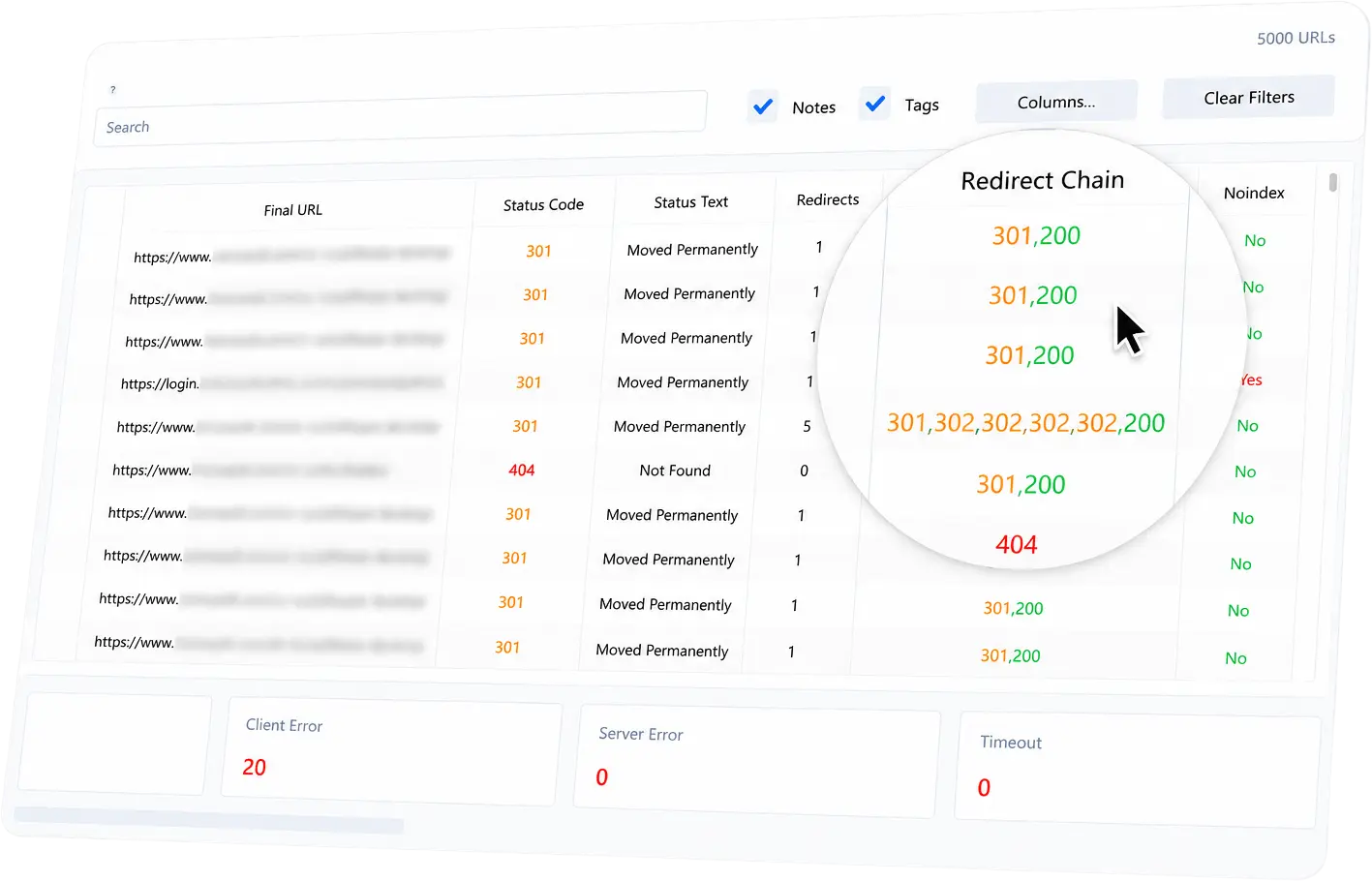
HTTP status codes look simple. A URL returns 200, 301, 404, 500, or something else, and the audit report turns that into a green, orange or red row. That simplicity is useful, but it can also be misleading. A status code is not just a label. It is part of a conversation between a client and a server, and that conversation can be affected by redirects, caches, CDNs, cookies, authentication, bot protection, TLS, proxies, content negotiation and request headers.
That is why experienced SEOs, developers and QA teams rarely look at the status code alone. They look at the original URL, the final URL, the status text, the redirect chain, the response headers, the content type, the response time and the error details together. A single 200 OK can hide the wrong canonical, a soft 404, a login page, a block page or a noindex directive. A 403 Forbidden may mean the page is protected, but it may also mean the server rejected the scanner because it did not look like a browser. A 301 may be perfectly correct, or it may be the first hop in a messy chain that ends somewhere nobody expected.
This guide goes deeper than a basic status code list. It explains what a URL checker actually sees, why status codes exist, why they are still useful across HTTP/1.1, HTTP/2 and HTTP/3, and how to interpret them properly during real audits.
If you want the practical workflow version, start with How to Bulk Check HTTP Status Codes. If you want to understand the protocol layer behind those results, this article is for you.
Status codes are not error messages
The first mental shift is this: HTTP status codes are not just errors. They are response classifications.
The first digit gives you the broad class of response:
-
1xxmeans the request is still in progress or needs an interim response. -
2xxmeans the request was successful in some way. -
3xxmeans more action is needed to complete the request, usually a redirect. -
4xxmeans the request could not be fulfilled from the client side of the exchange. -
5xxmeans the server failed to fulfil an apparently valid request.
That classification is deliberately broad. A URL audit tool does not need to know every possible code to understand the general type of result. If a server returned a new 4xx code tomorrow, the client could still treat it as a client error class even if it did not know the exact meaning yet.
This is one reason HTTP has lasted so long. It is extensible. New methods, headers and status codes can be introduced without redesigning the entire web.
A short history of status codes
In the very early web, HTTP was closer to a simple document retrieval mechanism. Over time, it needed richer signals. Clients needed to know whether a page was returned successfully, moved, missing, protected, cached, not modified or broken.
HTTP/1.0 formalised the idea of a response status line: protocol version, numeric status code and a reason phrase. A classic response started with something like:
HTTP/1.0 200 OK
HTTP/1.1 expanded and refined that model. Persistent connections, better caching, Host headers, more detailed semantics and redirect behaviour became increasingly important as the web moved from static documents to applications, APIs and large sites.
Modern HTTP specifications separate protocol semantics from wire format. This matters. The meaning of 200, 301 or 404 is not tied only to HTTP/1.1 text messages. HTTP/2 and HTTP/3 use different framing and transport mechanisms, but the semantic idea of a response status remains. A 404 means "not found" at the HTTP semantics level whether the connection is HTTP/1.1 over TCP, HTTP/2 over TLS, or HTTP/3 over QUIC.
For an audit tool, that is helpful. You care about the meaning of the response, not only the transport that carried it.
What a URL checker sends
A browser is a large interactive client. It stores cookies, runs JavaScript, follows complex authentication flows, fetches assets, renders layout, talks to extensions and often has a human sitting in front of it. A URL checker is different.
A bulk URL status checker sends direct HTTP requests to the URLs in your list. It follows redirects according to its settings, records the response, extracts metadata where possible and shows you the result in a table.
That directness is powerful because it removes a lot of browser noise. It is also why a checker can disagree with your browser.
A browser may already have a logged-in session. A checker may not. A browser may pass a bot challenge after JavaScript runs. A checker does not execute JavaScript. A browser may reuse cached assets or service workers. A checker is usually asking for the URL directly. A browser may send a very specific set of headers. A checker sends the headers it is configured to send.
Neither result is automatically "wrong". They are different clients asking the server for a response under different conditions.
For more on that difference, see Why a URL Works in Your Browser but Fails in a URL Checker.
Anatomy of a response
A useful URL audit is not just a status code. The response includes several layers of information.
The status code tells you the broad result.
The status text gives a human-readable phrase, although modern systems should not depend on it too heavily.
The headers provide metadata about the response. Headers can reveal the server, cache behaviour, content type, redirect target, robots directives, security policies, content encoding and more.
The body contains the response content, if there is one. For HTML pages, that is where title tags, meta descriptions, canonicals, robots meta tags, Open Graph data and hreflang alternates can be found.
URL Verifier Pro records the status code, status text, final URL, redirect count, redirect chain, response time, content type, content length, common headers and metadata fields. That combination is much more useful than a bare list of status codes.
Why 200 OK is not always good
A 200 OK response means the server successfully returned a representation for the request. It does not mean the page is useful, indexable, canonical, correct or even the page you expected.
During audits, inspect 200 rows for:
-
Wrong final URL after redirects.
-
Login pages returned instead of protected content.
-
Block pages returned with
200. -
Soft 404 pages.
-
Pages with
noindex. -
Pages canonicalising to another URL.
-
Incorrect content type.
-
Empty or thin responses.
-
Wrong language or regional version.
-
Staging content on production URLs.
This is why good URL audits do not stop at "status code is 200". A successful HTTP response can still be a failed business, SEO or migration result.
Why 3xx is not an error, but still needs review
Redirects are normal. HTTP to HTTPS redirects, trailing slash redirects, old-to-new migration redirects and canonical host redirects are all common.
The audit question is not "is there a redirect?" The question is "is this redirect correct?"
For every redirecting URL, review:
-
Final URL.
-
Final status code.
-
Redirect count.
-
Redirect chain.
-
Whether the redirect is permanent or temporary.
-
Whether the destination is relevant.
-
Whether the chain includes unnecessary hops.
-
Whether the chain loops or exceeds the limit.
-
Whether internal links and sitemaps still point at redirecting URLs.
A 301 > 200 pattern may be fine. A 301 > 301 > 302 > 200 pattern may indicate old rules layered on top of newer rules. A 301 > 404 pattern is a broken journey. A 302 found in a migration may be intentional, but it should be checked.
For a practical workflow, read How to Check Redirect Chains and Final URLs.
The messy world of 4xx
Client error responses are often the most misunderstood part of URL audits.
A 404 Not Found usually means the server does not have a resource at that URL. It may need a redirect, removal from the sitemap or no action if it is an intentionally dead URL.
A 410 Gone is stronger. It communicates that the resource is intentionally gone. That can be useful for content that should not return.
A 403 Forbidden is not the same as 404. It means the request was understood but refused. That refusal could be legitimate access control, missing authentication, a firewall rule, bot protection, IP blocking, a User-Agent issue or a server configuration choice.
A 429 Too Many Requests usually means rate limiting. When scanning large URL lists, this is a signal to slow down. Lower concurrency, lower per-host concurrency, add delay, add jitter, increase backoff and avoid hammering the same host.
Do not report every 403 or 429 as a broken page. Label them correctly. They are access or rate limit signals, not necessarily missing content.
5xx means the server side needs attention
Server errors deserve priority because they usually indicate something failing behind the URL. A 500 Internal Server Error, 502 Bad Gateway, 503 Service Unavailable or 504 Gateway Timeout can come from the application, origin server, reverse proxy, CDN, upstream dependency or gateway.
During an audit, look for patterns:
-
Are all
5xxURLs under one folder? -
Do they share a template?
-
Do they appear only after redirects?
-
Are they temporary and intermittent?
-
Do they happen only when concurrency is high?
-
Do they affect sitemap URLs?
-
Do they affect important landing pages?
-
Are they caused by a proxy route or direct origin issue?
A single 503 during maintenance may not be a serious SEO problem. Repeated 5xx responses across important pages should be escalated.
Headers often explain the status code
Response headers are the technical context around the status code.
For example:
-
Locationexplains where redirects point. -
Content-Typetells you whether the response is HTML, XML, PDF, JSON or something else. -
Cache-Control,ETag,Last-ModifiedandAgecan explain cache behaviour. -
ServerandViacan reveal layers such as proxies or CDNs. -
X-Robots-Tagcan apply indexing directives without HTML. -
Content-Encodingcan explain compressed responses. -
Security headers can reveal deployment differences across sections.
A row with 301 and a bad Location header is a different problem from a row with 301 and a correct direct destination. A row with 200 and X-Robots-Tag: noindex is a different problem from a normal indexable 200.
Use How to Check Response Headers in Bulk when headers are part of the investigation.
Caches can make results look inconsistent
HTTP caching is one reason two checks can disagree. A browser cache, shared proxy, CDN edge, reverse proxy or origin server can all influence what is returned and how quickly.
A cached redirect may continue to affect a browser after a server-side rule has changed. A CDN may serve stale content from one region but fresh content from another. A server may return different cache headers for HTML pages, XML sitemaps, PDFs and static assets.
This is not a reason to distrust results. It is a reason to read them carefully. If a scan shows old behaviour, check cache headers and retry after clearing or bypassing relevant caches where possible.
Status codes in SEO audits
For SEO, status codes are not ranking magic. They are crawl and indexing signals that affect whether search engines can access, follow, interpret and keep URLs in their index.
A clean audit usually aims for:
-
Important indexable pages returning
200. -
Old URLs redirecting cleanly to relevant new URLs.
-
XML sitemap URLs returning final canonical
200responses. -
Removed URLs returning appropriate
404or410responses. -
No important pages returning unexpected
403,429or5xx. -
No long redirect chains.
-
No noindex pages listed in sitemaps unless deliberate.
A status code report becomes more useful when it is tied to final URLs, canonicals, robots signals, metadata and notes. That is the difference between exporting a list of codes and delivering an audit people can act on.
A practical interpretation checklist
When reviewing status codes, ask:
-
Did the request complete?
-
Was the response from the expected host?
-
Did the URL redirect?
-
Where did it finish?
-
Was the final status successful?
-
Was the content type expected?
-
Did the page contain expected metadata?
-
Did headers include robots or cache signals?
-
Did the result depend on authentication, cookies, User-Agent or proxy settings?
-
Is this result an issue, or expected behaviour?
That final question matters. Good technical audits separate "different" from "wrong".
How URL Verifier Pro fits
URL Verifier Pro is built for exactly this kind of interpretation work. It is a native Windows app for checking large URL lists, reviewing status codes, redirect chains, headers, metadata, robots signals and errors in one table. It is not a full browser and not a full crawler. It is a focused bulk HTTP status code checker for known URLs, imported files and sitemap-discovered URLs.
The practical advantage is speed and control. You can scan the list, filter 3xx, 4xx, 5xx, Failed or Not Allowed rows, add notes, tag issues, save the session and export a CSV report that contains only the columns your audit needs.